In a 2026 TalentLMS survey, 90% of managers said they understood their direct reports’ skills, but only 69% of employees agreed. That perception gap helps explain why companies may miss capabilities already present in their teams. It does not prove that skills are absent from HR records.
The same survey found that 49% of employees say their skills are underused, while 56% say overlooked skills hold back their career growth at least sometimes. Half of all respondents said their organizations hire externally for skills that already exist internally. These are respondents’ perceptions, not an independent audit of skills or hiring practices.
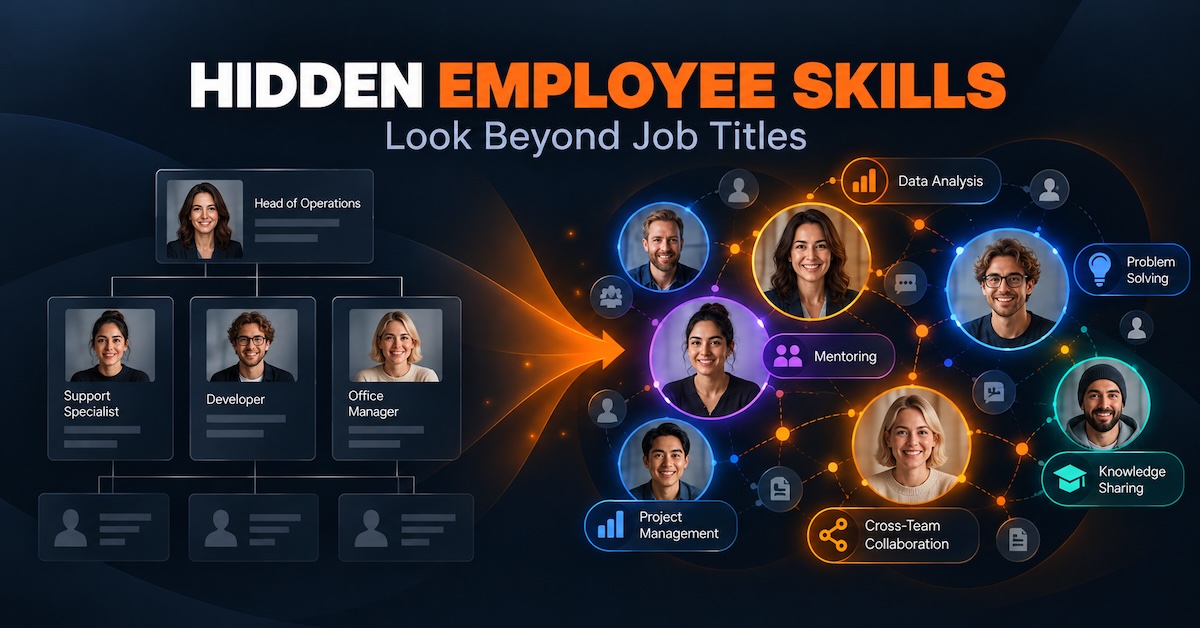
A job title describes a role, not everything a person can do. A support specialist may trace recurring problems, an analyst may help automate reports, and an individual contributor may teach a team. Those actions are reasons to investigate a skill, not proof of one.
What are hidden employee skills?
Hidden employee skills are capabilities people have or demonstrate at work that are missing from their job descriptions, skills profiles, or HR records. They may include technical knowledge from an earlier role, as well as problem-solving, mentoring, coordination, or knowledge-sharing skills.
Keep three levels distinct:
- Observed signal: a specific action, such as colleagues repeatedly asking someone for help with reports.
- Skill hypothesis: a possible capability, such as data analysis or reporting expertise.
- Verified skill: a capability supported by relevant work samples, a practical task, or a structured assessment.
Signals help you decide what to examine. An assessment tells you whether someone can perform the relevant work and at what level.
Why skills go unnoticed
HR systems are good at recording positions, departments, and role requirements. They capture less of the help colleagues give one another, experience from earlier work, independent learning, and contributions outside formal responsibilities.
Skills and business needs also change. The World Economic Forum estimates that employers expect 39% of workers’ core skills to change by 2030. Meanwhile, McKinsey’s HR Monitor 2026 reports that only 11% of surveyed organizations take a long-term approach to workforce planning. These findings describe survey responses and expectations, not every company’s situation.
Seven signals and the skills they may suggest
Recurring actions are more useful than mention counts. Use the table to form hypotheses, not to rate employees.
| Workplace signal | What it may suggest | What to examine |
|---|---|---|
| Colleagues from different teams repeatedly ask for help with a difficult task | Subject expertise, technical problem-solving | Task complexity, the person’s contribution, and whether they can reproduce the result. Requests may also reflect role duties or gaps in documentation. |
| Recognition describes a specific action and its result | Analysis, process improvement, technical capability | The employee’s actual contribution. Recognition frequency does not prove skill. See our guide to an employee recognition program. |
| Colleagues ask for explanations, onboarding help, or a tool demonstration | Subject knowledge, knowledge-sharing, mentoring | Participant feedback, clarity, and whether colleagues became more independent. Ask if the person wants to continue. |
| Someone notices recurring errors or delays | Root-cause analysis, quality management, process improvement | How the cause was found, what action followed, and what changed. Spotting and resolving a problem are distinct contributions. |
| A suggestion changes a real process or helps test an idea | Business understanding, analysis, problem-solving | Reasoning, feasibility, and the employee’s role in testing. Submission count is not a measure of competence. |
| Someone helps teams coordinate work or handoffs | Cross-functional knowledge, communication, coordination | Situation complexity and participant feedback. The person may be compensating for a weak process; do not make them the default intermediary without agreement and resources. |
| Someone succeeds at a bounded task outside their role | Capabilities demonstrated in that assignment | Predefined criteria, the work, and feedback. The assignment should be voluntary, fairly accessible, and resourced. |
How to identify employee skills: a five-step plan
Step 1: Define a specific business need
Start with a decision: whom to develop, which project to staff, or what capability the organization needs. Describe observable work rather than a broad label such as “leadership” or “analytics.” For example: “Can independently analyze sales data, find inconsistencies, and explain the findings.”
Step 2: Gather relevant evidence from more than one source
Review projects, work samples, employee profiles, training, manager observations, specific peer recognition, and mentoring or process-improvement activity. Each source has limits: self-reports can be out of date, managers see only part of the work, and recognition can favor visible roles. Multiple sources help form a better hypothesis, but they do not automatically prove it.
Step 3: Connect the hypothesis to a concrete action
Record the possible skill and the observation that prompted it. For example: “Possible skill: data analysis; evidence: the employee has repeatedly found report errors; next step: review a completed analytical project.” This keeps observation separate from interpretation and prevents a skills map from turning into a ranking.
Step 4: Validate the skill with a relevant assessment
Match the method to the capability: a practical task or work sample for a technical skill, observation in a relevant situation for communication, or project results and participant feedback for coordination. Use clear criteria. Give the employee a chance to explain their contribution and correct factual errors.
Step 5: Connect verified skills to opportunities
After validation, consider development, an internal project, or an invitation to apply for a relevant role. This does not mean an internal candidate is always the better choice. The goal is to make the decision with fuller information and avoid overlooking people because their current title does not match.
How skills visibility informs talent decisions
A clearer picture of capabilities can help an organization check for internal candidates before an external search, choose training more precisely, and find people for short-term projects. In LHH’s 2026 research, only 33% of surveyed CHROs reported a clear view of their workforce’s current and future skills. This is a CHRO survey finding, not a universal estimate of all employers.
Skills visibility may also reveal reliance on one expert and prompt knowledge transfer. That concern needs its own review: a person’s visibility alone does not prove dependency risk. See our guide to key person dependency.
How HiveHR helps surface employee contributions
HiveHR brings context to workplace actions through peer recognition, employee ideas, and problem reports. Recurring examples of help, knowledge-sharing, or process improvement can suggest capabilities worth examining.
The platform also helps teams examine workplace connections. These records reflect actions captured in the system, not everything an employee knows and not an independently verified skills profile. Before using a signal for a talent decision, validate it with an appropriate method and discuss it with the employee.
For more on responsible data use, read our guide to ONA privacy and ethics.
How to avoid reinforcing bias
- Do not confuse popularity with competence. Frequent recognition may reflect role visibility rather than skill level.
- Do not treat a missing signal as a missing skill. Work may be independent, confidential, or outside the channel being measured.
- Use data for a clear work-related purpose. Tell employees what is collected, who can see the results, and how they may be used.
- Do not let a system make consequential employment decisions. Hypotheses need human review, relevant criteria, and a way to correct inaccuracies.
- Review access and retention. Keep only the data needed for a defined purpose.
Frequently asked questions about hidden employee skills
How can HR identify hidden employee skills?
Combine work samples, projects, manager observations, specific peer feedback, and learning records. Then validate skills that matter to the business with a relevant assessment or practical task.
What is employee skills mapping?
It is the process of describing workforce capabilities and connecting them to business needs, roles, and development. A useful map shows the source of each conclusion and distinguishes self-reports, observed signals, and verified skills.
Can peer recognition reveal competencies?
Specific recognition can point to an action or contribution worth examining. It does not verify a competency and should not by itself determine promotion or performance ratings.
Can AI automatically assess employee skills?
AI can organize work evidence and suggest hypotheses. Before using those outputs for talent decisions, check their accuracy, fairness, and limits, and keep consequential decisions under accountable human review.
How does skills visibility support internal mobility?
It can surface candidates whose capabilities are not reflected in their current job titles. Verified skills can then be compared with the requirements of a role or development project.
Start with a question, not a ranking
Before recruiting for a capability, look at how it appears in your team’s work. Recurring actions can show what to investigate; an appropriate assessment can establish which skill is supported by evidence.
This gives HR and managers a more grounded basis for hiring, development, and internal opportunities—and helps keep visibility separate from ability.
See which workplace signals are visible in your team
Discuss a HiveHR pilot with a clear purpose, access rules, and data-retention period.
Sources
- TalentLMS: Skills Visibility Report 2026. Survey of 1,500 US employees and managers, March 2026.
- World Economic Forum: Future of Jobs Report 2025: Skills Outlook.
- McKinsey: HR Monitor 2026.
- LHH: If You Can't See Your Workforce, You'll Keep Hiring for It, 2026.